

Engineer Boots are tall enough that the way your jeans fall around the shaft matters almost as much as the jeans cut itself. The useful question is not simply whether a pair is labeled slim, straight, or relaxed. It is whether the actual hem clears the actual boot shaft—and whether the remaining length creates the line you want.
This guide is about jeans fitting around the shaft. Sizing, instep pressure, heel movement, and toe room belong to a different decision; see how Engineer Boots should fit on the foot for that.

Heel slip, instep, width and shaft fit explained separately from jeans-and-shaft clearance.
Why Leg Opening Matters More Than Color
With low shoes, the hem mainly meets the upper and sole. With Engineer Boots, it also has to move around a shaft that extends up the lower leg. If the opening is too narrow for that specific shaft, the denim may stop, ride up, or collect above the boot. That mechanical problem changes the silhouette before color has any chance to improve it.
A roomier opening is more likely to pass around the shaft and continue downward. A very wide leg can cover more of the boot and create a looser outline. Neither is automatically better: the goal is to make the fabric behave intentionally.
-
Leg opening
Will the hem pass around the shaft? -
Remaining length
Will it break, stack, or finish cleanly? -
Cuff
How much length and boot visibility changes? -
Desired view
Should the shaft disappear or stay visible?
The best diagnostic question is: Does this hem clear this particular boot shaft, and does the remaining length create the silhouette I want?
Why there is no magic number: shaft circumference, shaft shape, leather stiffness, calf size, denim weight, and brand measurement methods all vary. A leg-opening measurement may help you compare two pairs of jeans, but it cannot guarantee compatibility with every Engineer Boot.

Straight Jeans With Engineer Boots
Straight-leg jeans are often a useful starting point because the lower leg does not taper aggressively toward the ankle. That usually gives the hem a better chance of passing around the shaft. Still, “straight” is only a category name; actual openings vary by brand, size, and pattern.
For a cleaner hem
Use a length that reaches the boot without leaving much excess fabric. If the opening clears the shaft, the jeans can finish with a light break near the vamp and heel. The boot feels integrated into the outfit rather than deliberately framed.
For more break or stacking
Extra length creates more folds as the denim settles on the boot. That can suit the weight of an Engineer Boot, but look at where the folds begin. Fabric settling from the bottom up is intentional stacking; fabric trapped at the top of the shaft usually signals a clearance problem.
For more boot visibility
A cuff changes the effective length without changing the leg opening. An uncuffed straight jean creates a continuous line over the boot; a cuff can expose more shaft or buckle. This flexibility is why straight jeans are a sensible first pair to test—not proof that every straight jean will work.
Relaxed or Wider Jeans With Engineer Boots
Relaxed and wider jeans leave more fabric around the lower leg. They tend to cover more of the shaft and can create a softer, looser outline. They may also produce more visible folds over the vamp simply because more denim is available to drape.
For a controlled relaxed look, keep enough room to clear the shaft but avoid more length than the silhouette needs. For a deliberately stacked look, let additional length form several folds while checking that the hem is still moving freely around the boot.
As the leg gets wider, the buckle and upper shaft become less visible. That makes the jeans, rather than the boot, the dominant shape. Choose this because you want a broader trouser line—not because wider is automatically the “correct” fit.
Can Slim Jeans Work With Engineer Boots?
Yes, slim jeans can work with Engineer Boots if the actual hem clears the shaft. “Slim” may describe the seat and thigh as much as the ankle, so the label alone does not settle the question. Two slim fits can have very different lower-leg shapes.
If the hem catches, the denim can climb and bunch above the shaft. Shortening the jeans or adding a cuff may reduce excess length, but neither creates more opening. Tucking the jeans into the boot avoids the clearance issue by changing the silhouette entirely; it is a styling choice, not a repair for an incompatible over-the-boot fit.
Test slim jeans in motion: pull the hem over the shaft, stand naturally, then take several steps and sit down. If the hem rises and does not settle back, it may be catching even if it looked clean while you were still.
Should You Cuff Jeans With Engineer Boots?
You can wear Engineer Boots with or without a cuff. The cuff mainly changes effective length, the visual weight at the hem, and how much of the boot is visible. It does not fix a leg opening that cannot pass around the shaft.
No cuff
Creates the most continuous line from jeans to boot. Extra length can produce a light break or more stacking.
Single cuff
Removes some hanging length and can reveal more of the shaft while keeping the fold visually restrained.
Double or taller cuff
Draws more attention to the hem and boot. Heavy denim may make repeated folds feel bulky.

There is no universal cuff height. A useful cuff is one that leaves the hem at an intentional point when you stand and walk. If it creates a thick ring of fabric or lifts the jeans higher than intended, try a smaller fold, one fewer turn, or no cuff.
Jeans Over the Shaft vs Showing More Boot
Wearing jeans over the shaft is the more continuous option: the trouser line stays intact and the Engineer Boot reads mainly through its toe, heel, and sole. Showing more boot makes the shaft, buckle, and pull-on construction more prominent.
To reveal more of the boot, use a cuff or a shorter hem. To cover more of it, use an uncuffed hem with enough opening and length to fall around the shaft. Tucking the jeans into the boot makes the full shaft visible, but it creates a much more deliberate, boot-led silhouette.
None of these approaches is a fit requirement. Decide whether you want the jeans to frame the boot, cover it, or make it the focal point—then adjust the hem rather than relying on a rule.
Denim Color Comes After the Silhouette
Once the hem behaves correctly, color can refine the result. Black denim creates a dark, continuous line with black boots and stronger separation with brown boots. Indigo adds familiar denim contrast and changes as it fades. Ecru or natural denim creates the clearest contrast against dark leather and makes the hem line more visible.
Keep that decision separate from clearance and length. For the deeper wardrobe question, use the dedicated guide to black vs brown Engineer Boots.

Compare color, contrast and wardrobe compatibility after you have solved hem and shaft interaction.
Common Jeans-and-Boot Mistakes
1. Trusting the fit label instead of the hem
A straight jean can still taper near the ankle, while a slim jean may leave enough room. Compare the opening and test the real garment over the real boot.
2. Calling every fold “stacking”
Intentional stacking comes from extra length settling on the footwear. Bunching starts higher because the hem cannot move around the shaft. The source of the fold matters more than the number of folds.
3. Cuffing without rechecking the length
Every fold removes hanging length. Check the result standing, walking, and sitting; a cuff that looks balanced in one position may expose more shaft than expected in another.
4. Treating shaft height as the only boot variable
Height changes where the jeans meet the boot, but total profile also includes shaft shape, leather body, toe, heel, and outsole. Two boots with the same published height can look different beneath the same jeans.
5. Starting with color
A good color combination cannot correct a hem that rides up or a length that creates uncontrolled folds. Solve clearance, length, and cuffing first.
Quick Selector: Which Jeans Direction Should You Try?
| Desired result | A useful starting point | What to check |
|---|---|---|
| Clean everyday line | Straight jeans with limited excess length | The hem clears the shaft and finishes with a light break. |
| Relaxed workwear silhouette | Relaxed or wider jeans | The wider leg drapes rather than getting held up at the shaft. |
| More boot visible | Single cuff or shorter hem | The cuff stays balanced while standing, walking, and sitting. |
| Slimmer outline | Slim jeans with sufficient real opening | The hem settles back after movement instead of catching. |
| Deliberate stacking | Enough opening plus extra length | The folds begin near the boot, not above the shaft. |
| Dark continuous palette | Black denim | Confirm silhouette first, then choose boot color. |
| Classic denim contrast | Indigo denim | Consider how the denim fade changes the contrast over time. |
| Light, high-contrast look | Ecru or natural denim | The prominent hem line looks deliberate rather than accidental. |
A five-step mirror check
- Clearance: Can the hem pass around the shaft without force?
- Recovery: After a few steps, does it fall back into place?
- Length: Are the folds clean break, intentional stacking, or trapped bunching?
- Cuff: Does folding improve the proportion or add unwanted bulk?
- Visibility: Are you showing the amount of toe, buckle, and shaft you intended?
How Shaft Height and Boot Profile Change the Result
Product dimensions are useful comparison points, not jeans prescriptions. The current Uncle Hector examples below publish shaft height, but not shaft circumference. That means no product page supports a guaranteed leg-opening requirement.
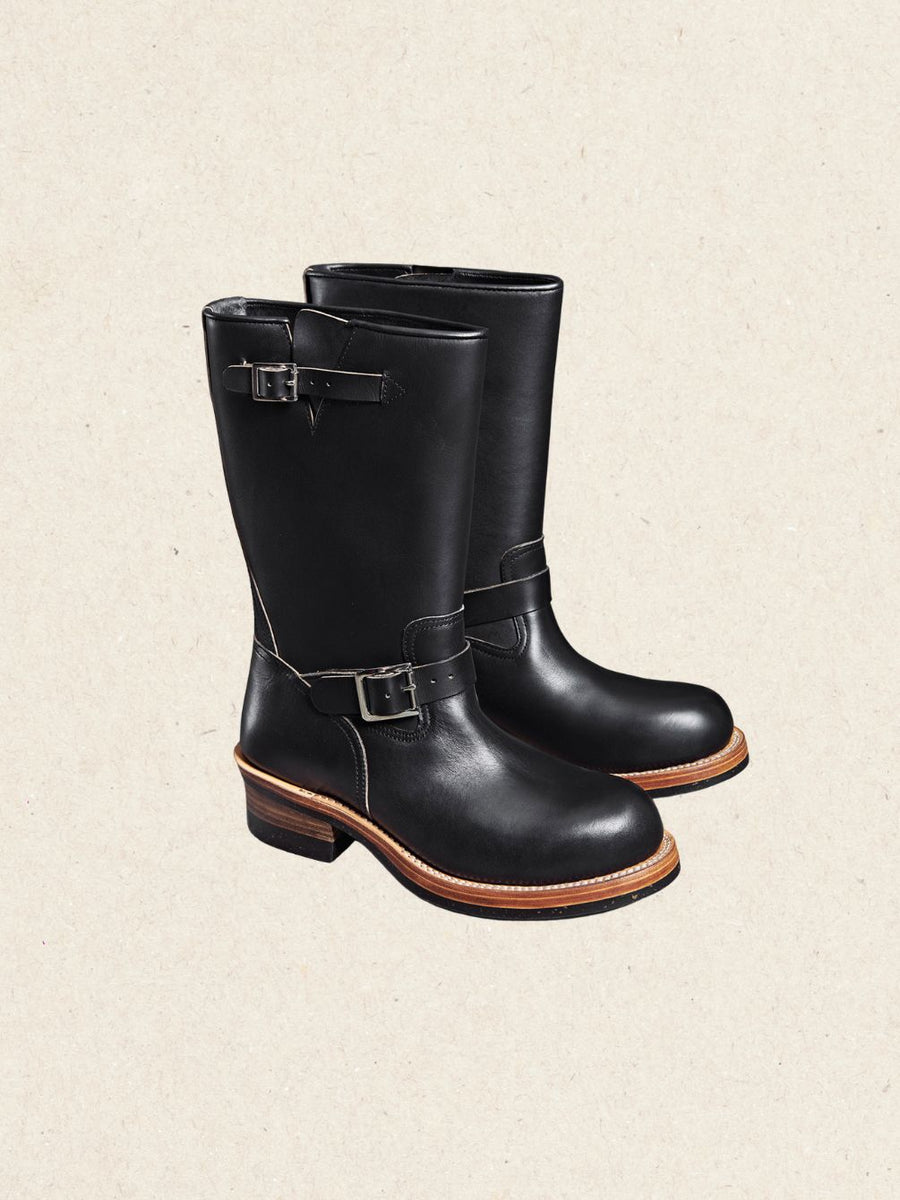
29 cm De-Waxed Calfskin Engineer Boots
29 cm shaft · 5 cm stacked heel · twin buckle straps · Vibram Mini Lug 430 · Goodyear welt
This is the tall reference. Its height changes where the jeans meet the boot, so actual hem clearance and drape deserve attention. Height does not reveal the shaft circumference.
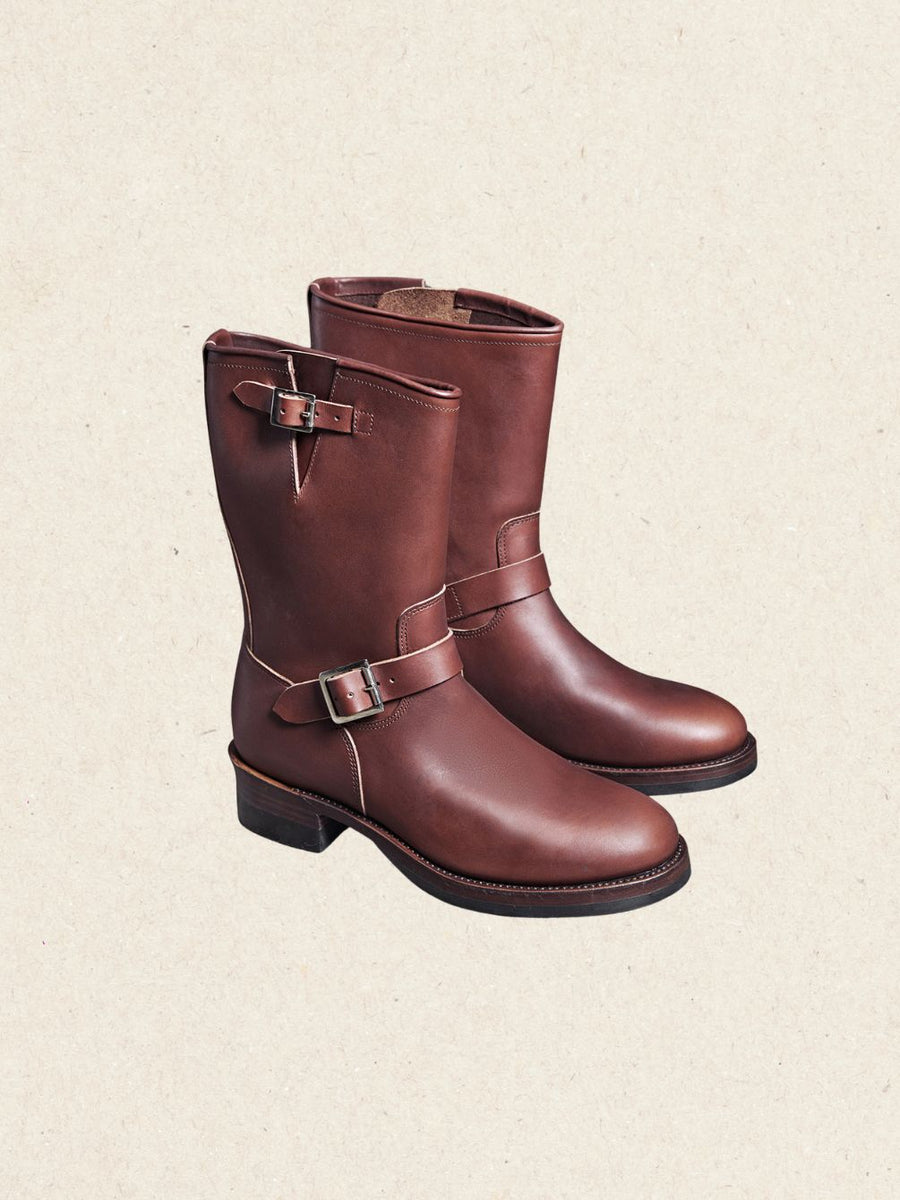
25 cm Short Engineer Boots
25 cm shaft · 3.5 cm heel · buckle strap · Vibram TYGUM 705 rubber · Goodyear welt
The shorter shaft creates a different meeting point under the jeans. It still does not guarantee that every straight or slim hem will clear the boot.
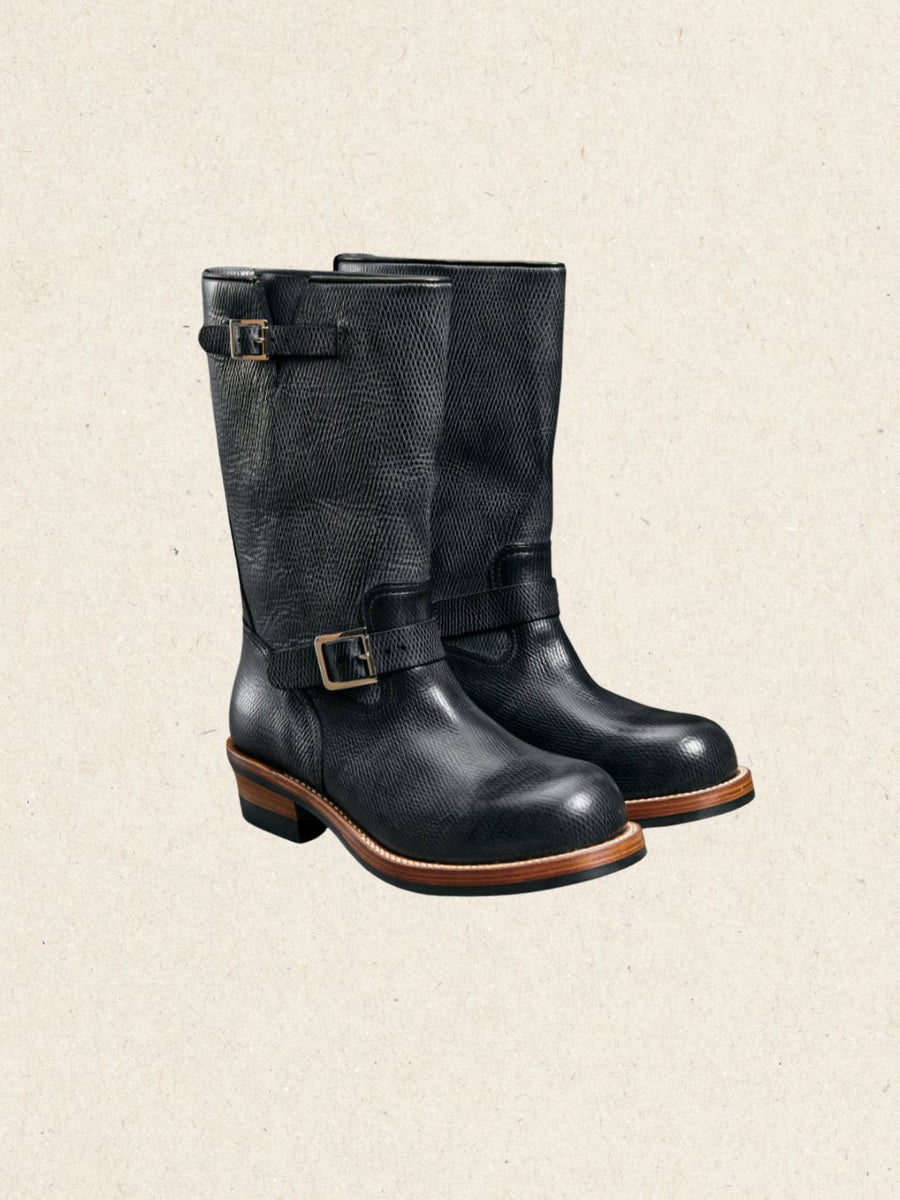
Chunky 29 cm Engineer Boots
29 cm shaft · documented heavy silhouette · 5 cm stacked heel · twin buckles · Vibram Mini Lug 430
This model shares the tall example’s published height but has a heavier overall profile. It shows why equal shaft height does not produce equal visual weight beneath the jeans.
After identifying the silhouette you want, you can compare Engineer Boots by shaft and silhouette. Check the exact product rather than assuming all models interact with denim in the same way.
The Final Decision Rule
Start with clearance, then control length, then choose a cuff, and only then refine color. Straight jeans are a useful default, relaxed jeans create more drape, and slim jeans can work when their actual hem clears the shaft. The right result is the one that remains intentional when you stand, walk, and sit.
Do not chase a universal measurement. Test the exact jeans with the exact boots and judge whether the fabric moves freely, settles naturally, and shows the amount of boot you want.
FAQ: Wearing Engineer Boots With Jeans
What jeans look best with Engineer Boots?
Straight jeans are a useful starting point because they often leave more room through the lower leg, but the best pair is the one whose actual hem clears the shaft and whose length creates your preferred break or stack. Relaxed and slim jeans can also work when those conditions are met.
Can you wear slim jeans with Engineer Boots?
Yes. Slim jeans can work if the hem passes around the boot shaft and settles back after movement. The word “slim” does not give an exact leg-opening measurement, so check the garment rather than relying on its fit label.
Should jeans cover Engineer Boots?
They can, but they do not have to. An uncuffed hem over the shaft creates a continuous trouser line; a cuff or shorter hem shows more shaft and buckle. Choose based on the silhouette you want, not a fixed rule.
Should I cuff jeans with Engineer Boots?
Cuff them when you want less hanging length or more boot visibility. A single cuff is usually visually quieter than a double or tall cuff, but denim weight, inseam, and the boot profile all affect the result. A cuff cannot fix an opening that is too narrow for the shaft.
Can you tuck jeans into Engineer Boots?
Yes, but tucking creates a deliberate boot-led silhouette and exposes the shaft. It is an alternative styling choice, not the default solution for jeans that fail to clear the shaft when worn over the boot.
How much stacking is too much with Engineer Boots?
There is no fixed number of folds. Stacking becomes excessive when it overwhelms the lower leg, hides the intended boot shape, or is actually fabric trapped above the shaft. Reduce length or change the cuff if the result looks uncontrolled.
Do straight-leg jeans work with Engineer Boots?
Often, but not automatically. Straight jeans usually taper less through the lower leg, yet their openings still vary. Confirm that the hem clears your specific boot and that the remaining length produces the finish you want.
Does Engineer Boot shaft height affect which jeans work best?
Shaft height changes where the jeans meet the boot, so it affects what you should inspect. It does not determine the required leg opening by itself because shaft circumference, shape, leather structure, and the wearer’s calf also matter.


